03 Jun Seven Flowers That Changed the World
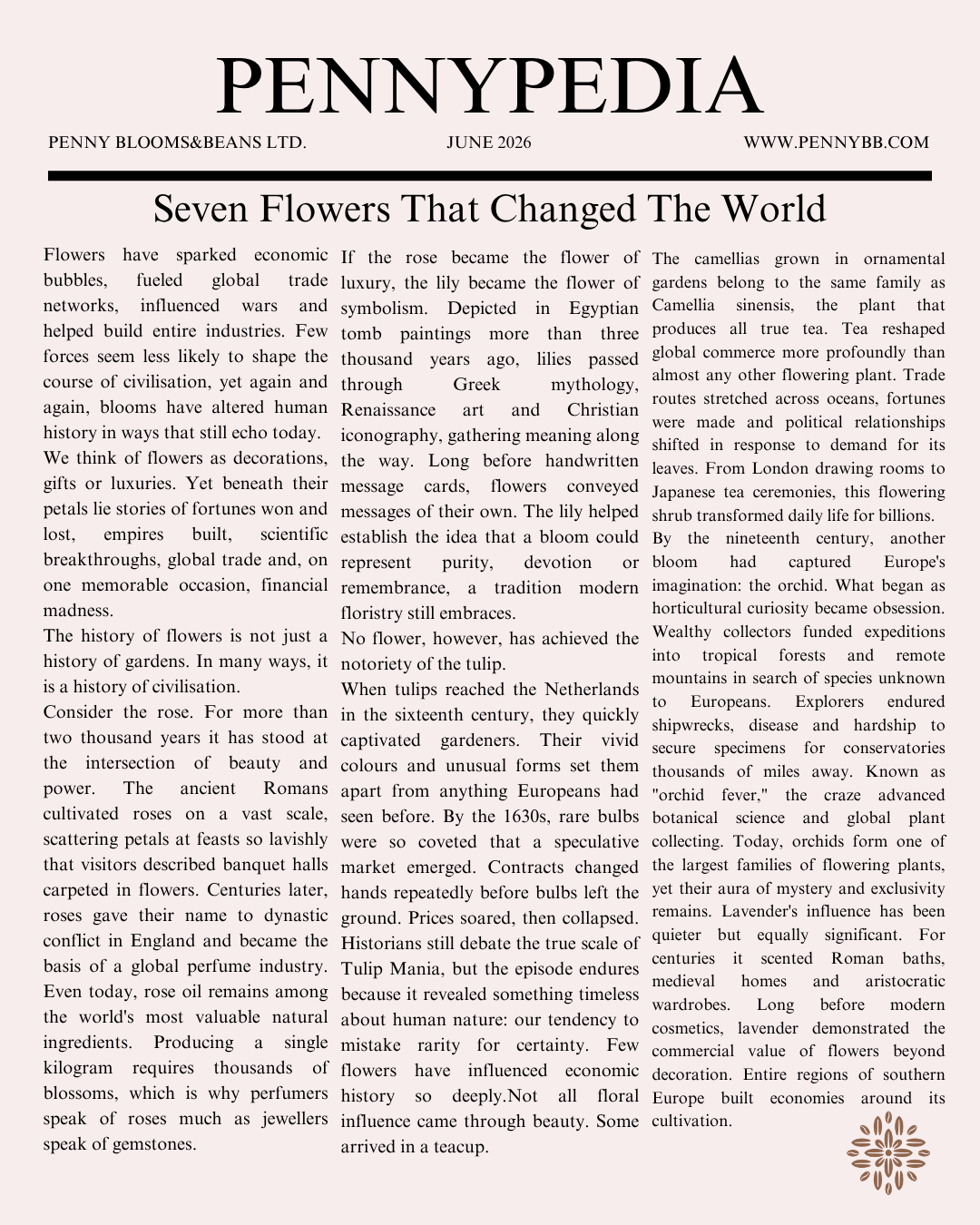
Flowers have sparked economic bubbles, fueled global trade networks, influenced wars and helped build entire industries. Few forces seem less likely to shape the course of civilisation, yet again and again, blooms have altered human history in ways that still echo today.
We think of flowers as decorations, gifts or luxuries. Yet beneath their petals lie stories of fortunes won and lost, empires built, scientific breakthroughs, global trade and, on one memorable occasion, financial madness.
The history of flowers is not just a history of gardens. In many ways, it is a history of civilisation.
Consider the rose. For more than two thousand years it has stood at the intersection of beauty and power. The ancient Romans cultivated roses on a vast scale, scattering petals at feasts so lavishly that visitors described banquet halls carpeted in flowers. Centuries later, roses gave their name to dynastic conflict in England and became the basis of a global perfume industry. Even today, rose oil remains among the world’s most valuable natural ingredients. Producing a single kilogram requires thousands of blossoms, which is why perfumers speak of roses much as jewellers speak of gemstones.
If the rose became the flower of luxury, the lily became the flower of symbolism. Depicted in Egyptian tomb paintings more than three thousand years ago, lilies passed through Greek mythology, Renaissance art and Christian iconography, gathering meaning along the way. Long before handwritten message cards, flowers conveyed messages of their own. The lily helped establish the idea that a bloom could represent purity, devotion or remembrance, a tradition modern floristry still embraces.
No flower, however, has achieved the notoriety of the tulip.
When tulips reached the Netherlands in the sixteenth century, they quickly captivated gardeners. Their vivid colours and unusual forms set them apart from anything Europeans had seen before. By the 1630s, rare bulbs were so coveted that a speculative market emerged. Contracts changed hands repeatedly before bulbs left the ground. Prices soared, then collapsed. Historians still debate the true scale of Tulip Mania, but the episode endures because it revealed something timeless about human nature: our tendency to mistake rarity for certainty. Few flowers have influenced economic history so deeply.
Not all floral influence came through beauty. Some arrived in a teacup.
The camellias grown in ornamental gardens belong to the same family as Camellia sinensis, the plant that produces all true tea. Tea reshaped global commerce more profoundly than almost any other flowering plant. Trade routes stretched across oceans, fortunes were made and political relationships shifted in response to demand for its leaves. From London drawing rooms to Japanese tea ceremonies, this flowering shrub transformed daily life for billions.
By the nineteenth century, another bloom had captured Europe’s imagination: the orchid. What began as horticultural curiosity became obsession. Wealthy collectors funded expeditions into tropical forests and remote mountains in search of species unknown to Europeans. Explorers endured shipwrecks, disease and hardship to secure specimens for conservatories thousands of miles away. Known as “orchid fever,” the craze advanced botanical science and global plant collecting. Today, orchids form one of the largest families of flowering plants, yet their aura of mystery and exclusivity remains.
Lavender’s influence has been quieter but equally significant. For centuries it scented Roman baths, medieval homes and aristocratic wardrobes. Long before modern cosmetics, lavender demonstrated the commercial value of flowers beyond decoration. Entire regions of southern Europe built economies around its cultivation. The idea that a flower could be harvested, distilled and turned into a luxury product owes much to lavender.
Then there is the sunflower, perhaps the most optimistic flower ever cultivated. Native to the Americas, it spread across continents and became one of the world’s most important crops. Its seeds and oils helped feed growing populations, while its towering blooms inspired artists and poets. When Vincent van Gogh painted his famous sunflowers, he was capturing more than a flower. He was depicting abundance, resilience and light.
Together, these seven flowers reveal an unexpected truth: flowers have never existed on the margins of history. They have shaped it. They inspired explorers to cross oceans, traders to build fortunes, artists to create masterpieces and societies to find meaning in the natural world.
Perhaps that is why flowers still matter. A bouquet may seem fleeting, lasting only days. Yet the stories within its stems have endured for centuries. Behind every petal lies a chapter of human history, reminding us that some of the world’s most influential forces arrived not with noise or power, but in bloom.