
The Flower Hunters
The remarkable men and women who changed the way the world blooms
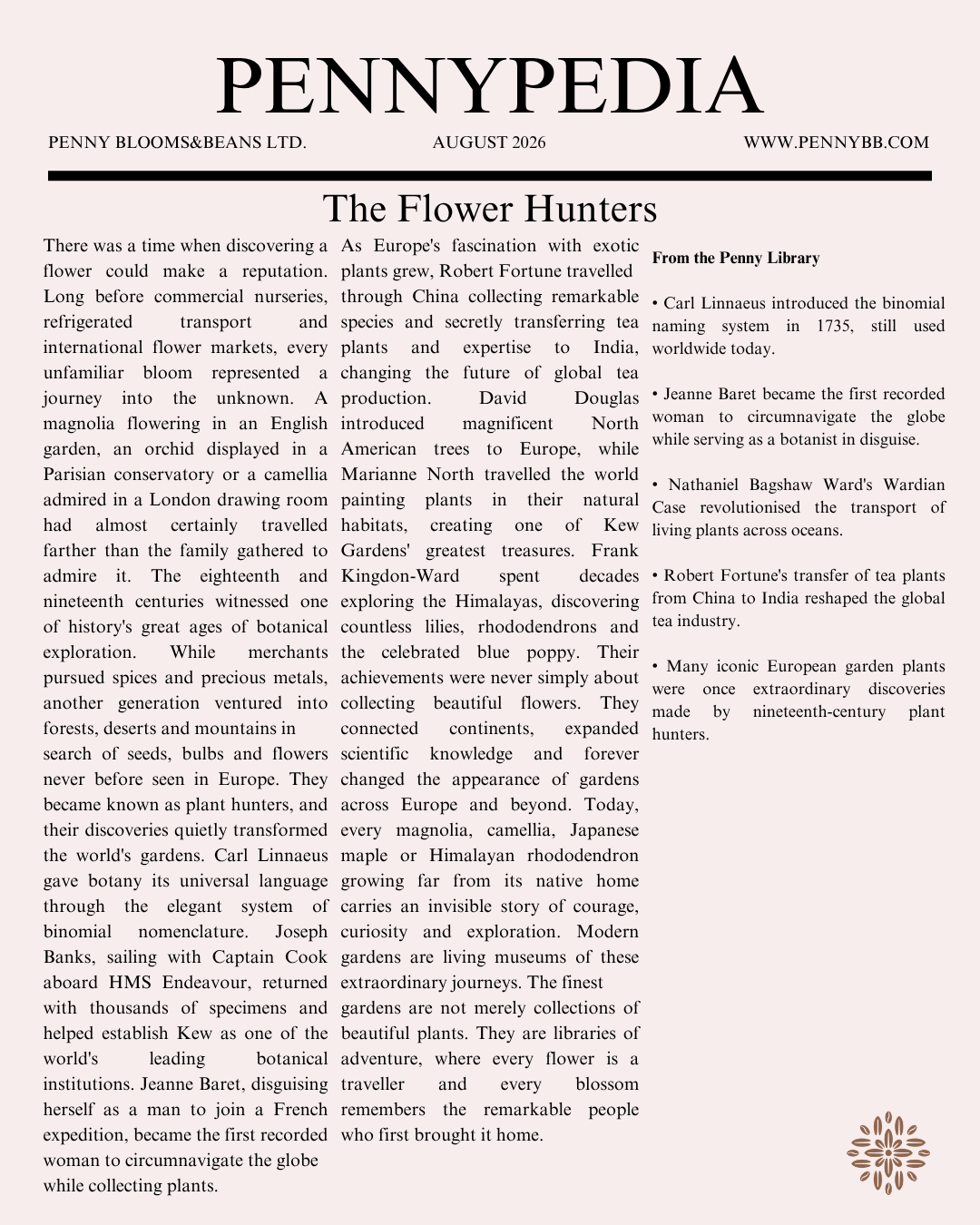
There was a time when discovering a flower could make a reputation. Long before commercial nurseries, refrigerated transport and international flower markets, every unfamiliar bloom represented a journey into the unknown. A magnolia flowering in an English garden, an orchid displayed in a Parisian conservatory or a camellia admired in a London drawing room had almost certainly travelled farther than the family gathered to admire it.
The eighteenth and nineteenth centuries witnessed one of history's great ages of botanical exploration. While merchants pursued spices and precious metals, another generation ventured into forests, deserts and mountains in search of seeds, bulbs and flowers never before seen in Europe. They became known as plant hunters, and their discoveries quietly transformed the world's gardens.
Carl Linnaeus gave botany its universal language through the elegant system of binomial nomenclature, which he introduced in 1735 and which is still used worldwide today. Joseph Banks, sailing with Captain Cook aboard HMS Endeavour, returned with thousands of specimens and helped establish Kew as one of the world's leading botanical institutions. Jeanne Baret, disguising herself as a man to join a French expedition, became the first recorded woman to circumnavigate the globe while serving as a botanist in disguise. As Europe's fascination with exotic plants grew, Robert Fortune travelled through China collecting remarkable species and secretly transferring tea plants and expertise to India, a transfer that reshaped the future of global tea production. David Douglas introduced magnificent North American trees to Europe, while Marianne North travelled the world painting plants in their natural habitats, creating one of Kew Gardens' greatest treasures. Frank Kingdon-Ward spent decades exploring the Himalayas, discovering countless lilies, rhododendrons and the celebrated blue poppy. None of these journeys would have been possible in the same way without Nathaniel Bagshaw Ward, whose Wardian Case revolutionised the transport of living plants across oceans and allowed fragile specimens to survive long voyages home.
Their achievements were never simply about collecting beautiful flowers. They connected continents, expanded scientific knowledge and forever changed the appearance of gardens across Europe and beyond. Today, every magnolia, camellia, Japanese maple or Himalayan rhododendron growing far from its native home carries an invisible story of courage, curiosity and exploration. Many of the iconic European garden plants we take for granted were once extraordinary discoveries made by these nineteenth-century plant hunters.
Modern gardens are living museums of these extraordinary journeys. The finest gardens are not merely collections of beautiful plants; they are libraries of adventure, where every flower is a traveller and every blossom remembers the remarkable people who first brought it home.